
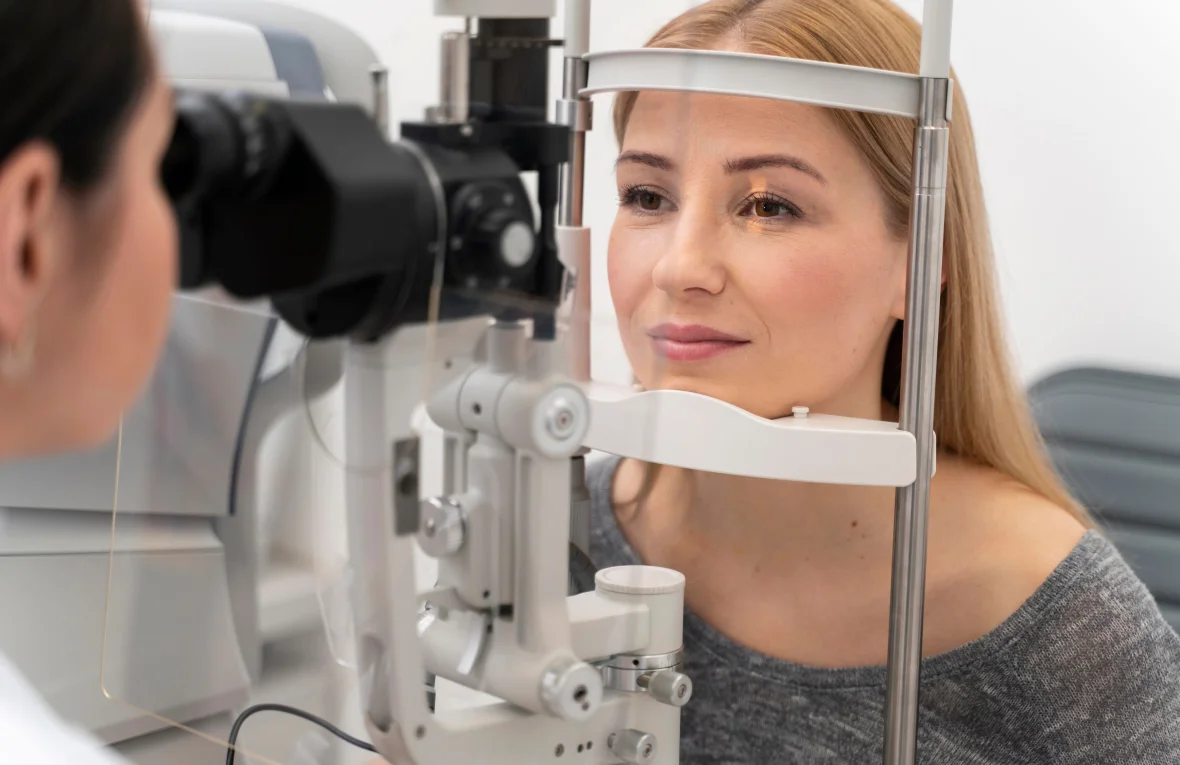
What Is Low Vision?
Low vision refers to a significant visual impairment that cannot be fully corrected with conventional glasses, contact lenses, medication, or surgery. It is distinct from total blindness — patients with low vision retain some useful functional vision, but that vision is limited enough to affect daily tasks like reading, recognising faces, watching television, or moving safely around familiar environments. The World Health Organization defines low vision as visual acuity of less than 6/18 in the better eye after best correction, or a significant visual field restriction.
Low vision is most commonly a consequence of eye diseases that have caused irreversible damage despite appropriate treatment. Age-related macular degeneration is a major cause, particularly in elderly patients where central vision loss leaves only peripheral vision intact. Advanced glaucoma can reduce the visual field to a small central island. Diabetic retinopathy, retinal dystrophies, optic atrophy, and high myopia with associated retinal changes are other frequent contributors. In some cases, low vision is present from birth or childhood due to congenital or hereditary conditions.
The Impact of Low Vision on Daily Life
The functional impact of low vision extends well beyond the clinical measure of visual acuity. Reading — whether books, newspapers, medication labels, or mobile phones — becomes laborious or impossible without assistance. Cooking, household management, and personal care require adaptation. Independence in travel and navigation is compromised, often leading to withdrawal from social activities. Employment and education may be affected. The psychological toll is significant — rates of depression and social isolation are markedly higher among those with visual impairment than in the general population.
These real-life consequences are what make low vision rehabilitation important. The goal is not to restore normal vision — that is beyond current medical capability in many of these conditions — but to maximise the use of whatever vision remains, and to equip patients with tools and strategies that restore as much independence and quality of life as possible.
What Low Vision Rehabilitation Involves
A low vision assessment begins with a detailed evaluation of functional vision — not just the standard Snellen acuity chart but an assessment of how the patient is using their vision in real-world tasks. The type of visual loss matters enormously: central scotoma (central vision loss as in macular disease) requires different strategies and aids than peripheral constriction (as in glaucoma), and different still from patchy field loss or contrast sensitivity problems.
Optical low vision aids include magnifiers — hand-held, stand-mounted, or spectacle-mounted — that enlarge images for reading and near tasks. Telescopic aids can help with distance tasks like reading a whiteboard or watching television. High-addition reading spectacles provide significant magnification for near work. For patients with central scotoma, training in eccentric viewing — learning to use a slightly off-centre part of the retina for fixation — can dramatically improve functional vision even without any optical device.
Non-optical aids include improved lighting (adequate, well-directed light makes a significant difference for most low vision patients), high-contrast materials, large-print books, talking watches and appliances, and screen-reading or magnification software for computers and mobile devices. The choice of aids is always personalised — what works well for one patient may not suit another, depending on the type and degree of vision loss, manual dexterity, age, and specific goals.
Low Vision Services at Neyera Magic Eye Care
At Neyera Magic Eye Care in Khandeshwar, we believe that being told nothing more can be done medically is not the end of the road. Low vision services represent the next stage — helping patients adapt, function, and maintain their dignity and independence despite permanent visual impairment. We offer low vision assessments and aid prescription, counselling for patients and families, and referral to appropriate rehabilitation professionals and support organisations.
If you or a family member has been diagnosed with an eye condition that has resulted in significant permanent vision loss, or if standard glasses are no longer providing adequate function, please reach out to us. Serving patients from Khandeshwar, Panvel, Kharghar, Belapur, Taloja, Alibagh, and across Navi Mumbai, we are here to help you make the most of your vision. Call 9559550957 or email info@neyeramagic.com.
Frequently Asked Questions
How often should I have an eye exam?
It’s recommended that adults have a comprehensive eye exam every 1-2 years, even if your vision seems fine. For children, their first eye exam should be at 6 months, followed by another at 3 years old, and then annually during school years. If you wear glasses or contact lenses or have a medical condition like diabetes, you may need more frequent exams.
What are the signs that I need glasses?
If you’re experiencing frequent headaches, eye strain, blurry vision (either up close or at a distance), difficulty seeing at night, or squinting to focus, these could be signs that you need glasses. A comprehensive eye exam will determine if corrective lenses are necessary.