
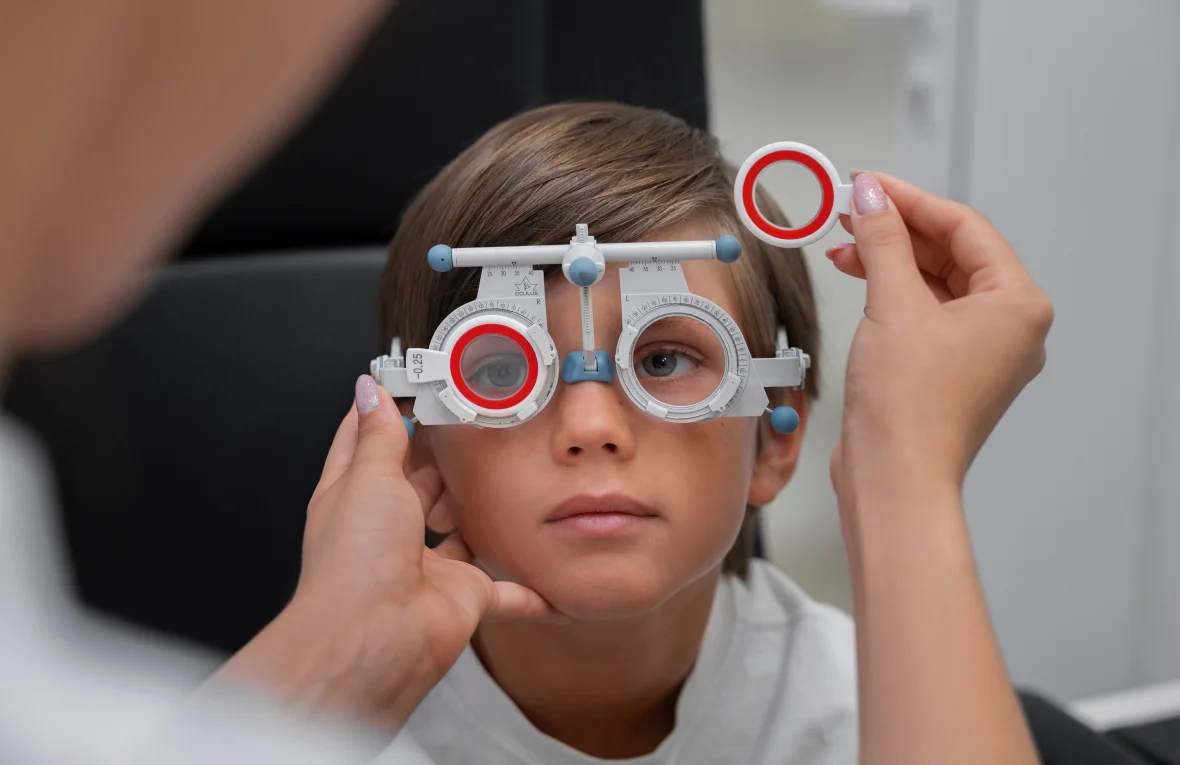
Why Children's Eye Health Deserves Special Attention
Children are not simply small adults when it comes to eye health. Their visual system is still developing through the first decade of life, and this developmental period makes childhood the critical window for identifying and treating eye conditions that could otherwise lead to permanent vision impairment. Many serious eye problems in adults — including lazy eye, squint-related vision loss, and refractive amblyopia — could have been entirely prevented or significantly reduced with timely intervention in childhood.
Yet children rarely complain about poor vision. They adapt remarkably well to what they see, often having no frame of reference for what ‘normal’ vision should feel like. A child with significant power in one eye, or a misaligned eye, may function seemingly normally in daily activities while unknowingly missing critical developmental milestones in their visual cortex. This is why routine eye examinations for children — regardless of whether parents notice a problem — are strongly recommended from infancy through school age.
Understanding Squint (Strabismus)
Squint, known medically as strabismus, is a condition where the two eyes do not point in the same direction. One eye may turn inward (esotropia), outward (exotropia), upward or downward. It can be constant or intermittent, present in one eye only or alternating between eyes. Some cases are obvious — a clearly crossed or wandering eye that parents notice easily. Others are subtle, presenting only occasionally when the child is tired or focusing on near objects.
Beyond the cosmetic and social implications, squint has direct functional consequences. When the eyes are misaligned, the brain receives two different images. To avoid the confusion of double vision, it learns to suppress the signal from the misaligned eye. Over time, if the suppressed eye does not receive adequate visual stimulation during the critical period of development, it fails to develop normal visual acuity — this is amblyopia, or lazy eye. It is important to understand that amblyopia is a brain problem, not just an eye problem, and it must be treated during childhood when the visual cortex is still malleable.
Treatment of Squint and Amblyopia
Treatment of squint depends on the type, severity, and underlying cause. Some forms of accommodative esotropia (inward squint triggered by the effort to focus) respond well to glasses alone, as correcting the refractive error removes the stimulus for the squint. Other cases require surgery to adjust the tension in the eye muscles, aligning the eyes more symmetrically. Surgery is typically performed under general anaesthesia in children and is a well-tolerated, effective procedure when performed by a specialist.
Amblyopia treatment involves stimulating the weaker eye to develop better vision, usually by patching or penalising the stronger eye with atropine drops. Glasses correction is often part of the treatment. The earlier amblyopia is detected and treated, the better the visual outcome — results diminish significantly after age 8-9, as the visual cortex becomes less responsive to stimulation. This is why parents should not take a ‘wait and see’ approach when squint or any visual concern is noticed in a child.
Other Pediatric Eye Conditions We Evaluate and Manage
Beyond squint and amblyopia, pediatric ophthalmology covers a range of conditions. Congenital nasolacrimal duct obstruction — causing persistent watering and discharge from infancy — is common and usually resolves with massage but occasionally requires probing. Congenital cataracts, while less common, require urgent treatment as they can irreversibly impair visual development if left in place. Childhood glaucoma, retinopathy of prematurity (in premature infants), and hereditary retinal conditions also require specialist evaluation.
Increasing myopia (short-sightedness) in school-age children is a growing public health concern, and early intervention — whether through lifestyle counselling, special contact lenses, or atropine therapy — has been shown to slow its progression. At Neyera Magic Eye Care, we take a comprehensive, evidence-based approach to managing childhood myopia rather than simply prescribing stronger glasses at each visit.
Pediatric Eye Care at Neyera Magic Eye Care, Khandeshwar
At Neyera Magic Eye Care, we understand that bringing a child for an eye examination requires trust. Our approach is calm, patient, and child-friendly — we take the time needed to build rapport, use age-appropriate examination techniques, and explain findings clearly to parents. Whether you have noticed an eye turning, your child is squinting or complaining of headaches, their school performance is declining, or you simply want a routine check, we welcome you. Serving families from Khandeshwar, Panvel, Kharghar, Belapur, Taloja, and Navi Mumbai. Call 9559550957 or email info@neyeramagic.com.
Frequently Asked Questions
How often should I have an eye exam?
It’s recommended that adults have a comprehensive eye exam every 1-2 years, even if your vision seems fine. For children, their first eye exam should be at 6 months, followed by another at 3 years old, and then annually during school years. If you wear glasses or contact lenses or have a medical condition like diabetes, you may need more frequent exams.
What are the signs that I need glasses?
If you’re experiencing frequent headaches, eye strain, blurry vision (either up close or at a distance), difficulty seeing at night, or squinting to focus, these could be signs that you need glasses. A comprehensive eye exam will determine if corrective lenses are necessary.
What causes dry eyes, and how can I treat it?
Dry eyes can be caused by aging, certain medications, environmental factors, or prolonged screen use. Treatment options include artificial tears, prescription eye drops, and lifestyle adjustments such as taking breaks from screens. An eye doctor can recommend the best course of treatment based on the severity of your symptoms.
Are there ways to prevent common eye diseases like glaucoma or cataracts?
While you can’t always prevent eye diseases, there are steps you can take to reduce your risk. These include wearing UV-blocking sunglasses, eating a healthy diet rich in antioxidants, avoiding smoking, and having regular eye exams to catch any issues early. Managing conditions like diabetes or high blood pressure can also help protect your eye health.